Pedigree
PEDIGREE collates an Army solicitation against the ones that came before it, instrument by instrument, and resolves every cell to the paragraph it came from. It marks the difference between an obligation that is not there and one it could not read, because those are not the same finding and a table that blurs them is worse than no table.
The problem
Every requirement in a new solicitation was written by someone looking at an old one. The old one is public. It is also unindexed, unstructured, and forty pages into an attachment, so in practice the lookup does not happen and the requirement gets copied by habit.
seven instruments, five authors
Seven Active DIDs obligate digital engineering artifacts. Five organizations wrote them across four years, and four of the seven were issued or revised in 2026. One is Army.
Nothing coordinates them, and nothing shows which solicitations invoked which.
a directive with no instrument
Army Directive 2024-03 §5.b(5) directs ASA(ALT) to "generate common Contract Data Requirements Lists (CDRLs) to enable consistency in DE products delivered to the Army."
Choosing among seven overlapping instruments is the problem that directive names, and nobody can see which of them programs actually reach for.
the signal is in the attachments
A SAM description field is capped at 32,003 characters. The richest performance work statement we measured runs to 108,391, and it lives in an attachment.
Searching descriptions for "digital engineering" across 15,814 Army notices returned four. The obligations are in the files, not the metadata.
rights decided by default
The 40 DFARS 252.227 clauses decide who may reuse a delivered model, and they arrive as boilerplate.
What a comparable program actually invoked, and what it was held to, is not visible at the moment the choice is made.
policy cannot see its own uptake
A policy is a document, so it can be the Subject. Diffed against practice, an instrument the policy expects that programs do not invoke is a Gap, and one programs invoke that the policy never named is an Outlier.
Drawing only the Gap answers only the question the reader already knew to ask.
the confident wrong answer
A system that fills a gap with a plausible figure puts an unsourced number into a solicitation, carrying the authority of a table.
That is the failure that has to be zero, and it is worth a great many blanks to buy.
What you see
No mockups and no sample data. The Subject is solicitation W58RGZ-26-R-0028, and the corpus is 245 Army solicitations posted between January and July 2026.
The Subject is pinned at the top. Under it sit the comparable solicitations the rule selected, and under those, the rate at which the whole corpus invokes each instrument.
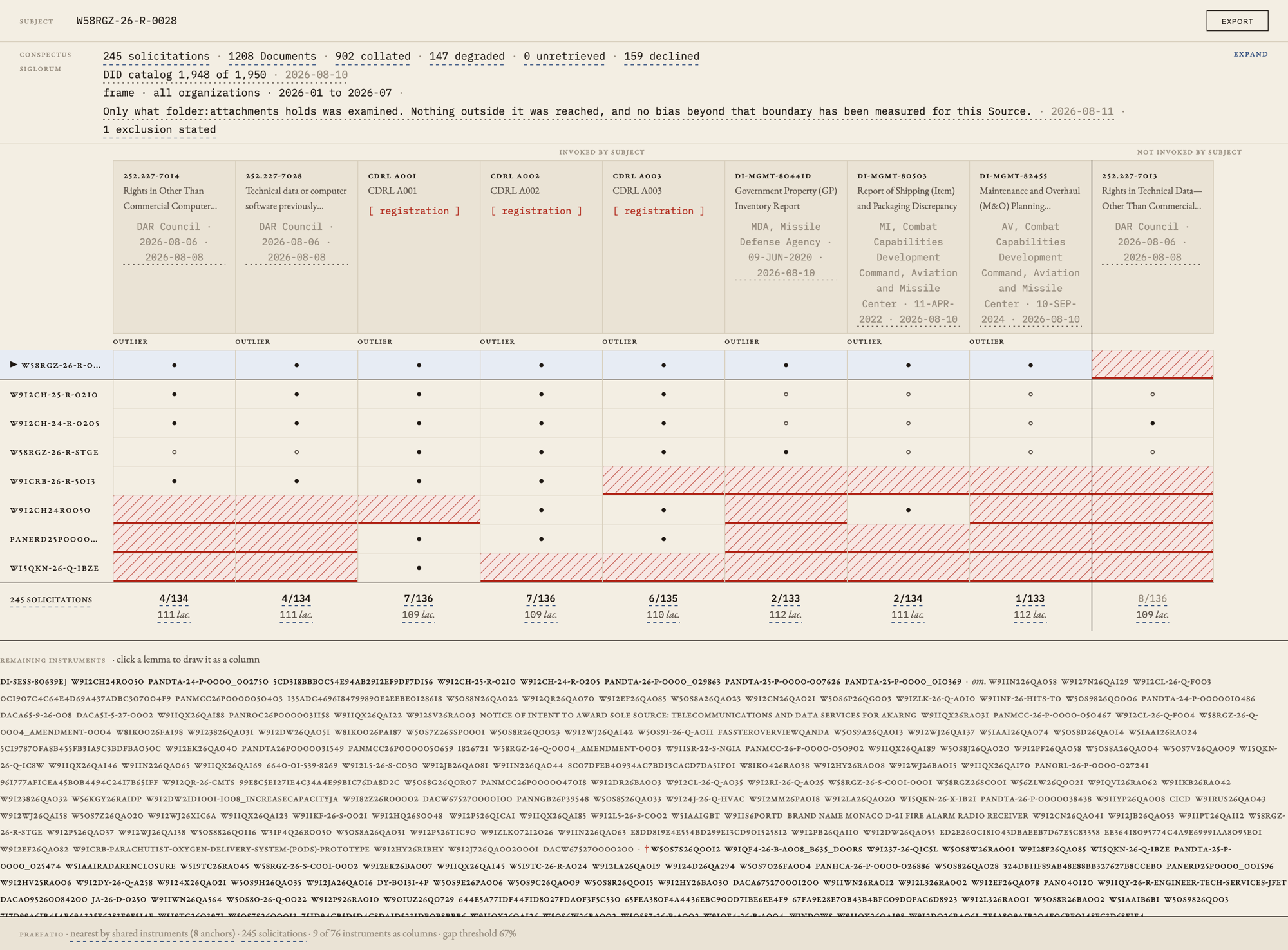
Clicking a cell opens the citations behind it, each with the file, the byte offset, the page, and the surrounding text.
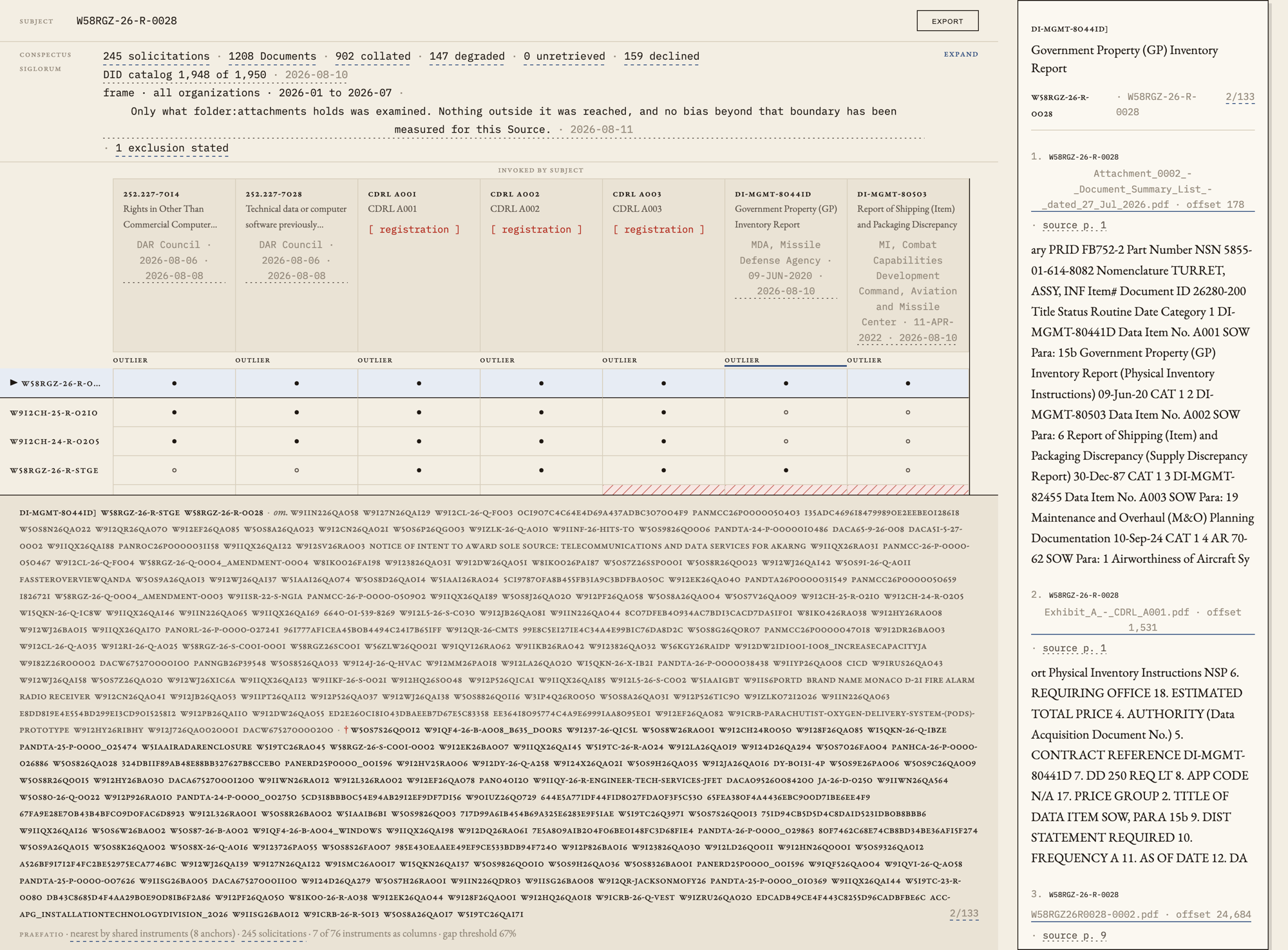
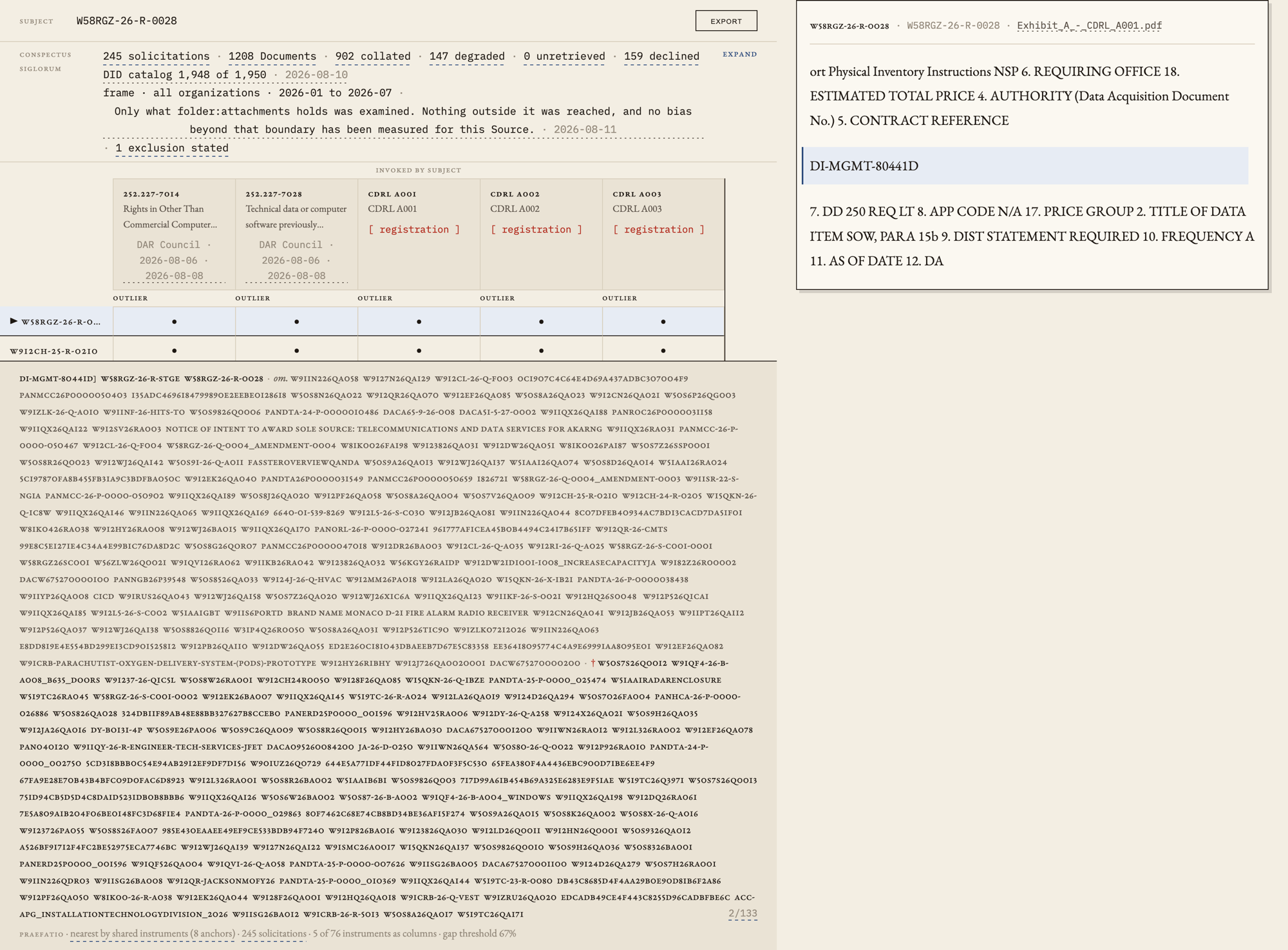
One more click reaches the document itself with the cited span marked in place.
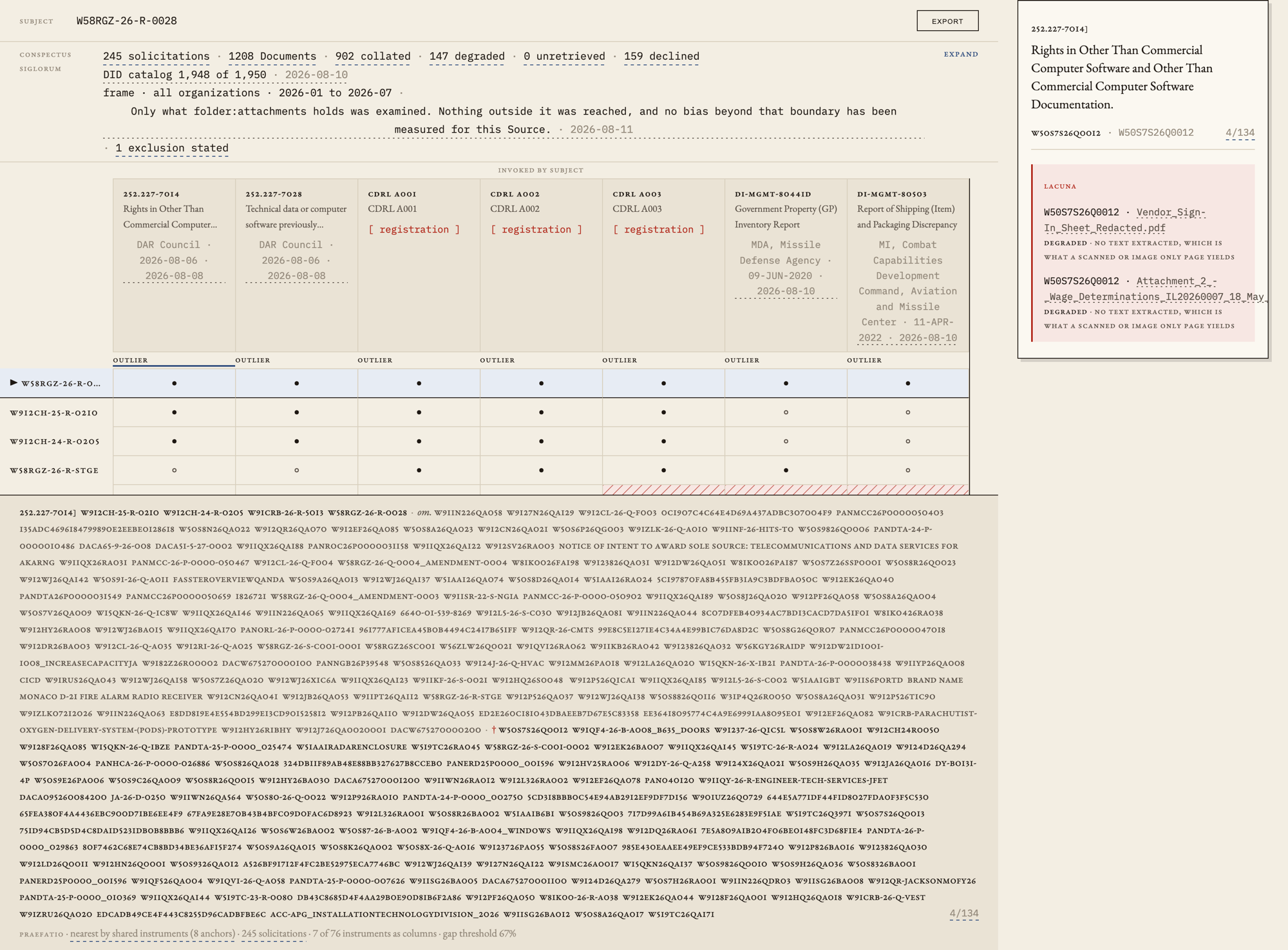
A blank cell opens to the documents that blocked it, each named, each with its condition.
Every document in the corpus, its source, and its condition, with the declined ones listed rather than dropped.
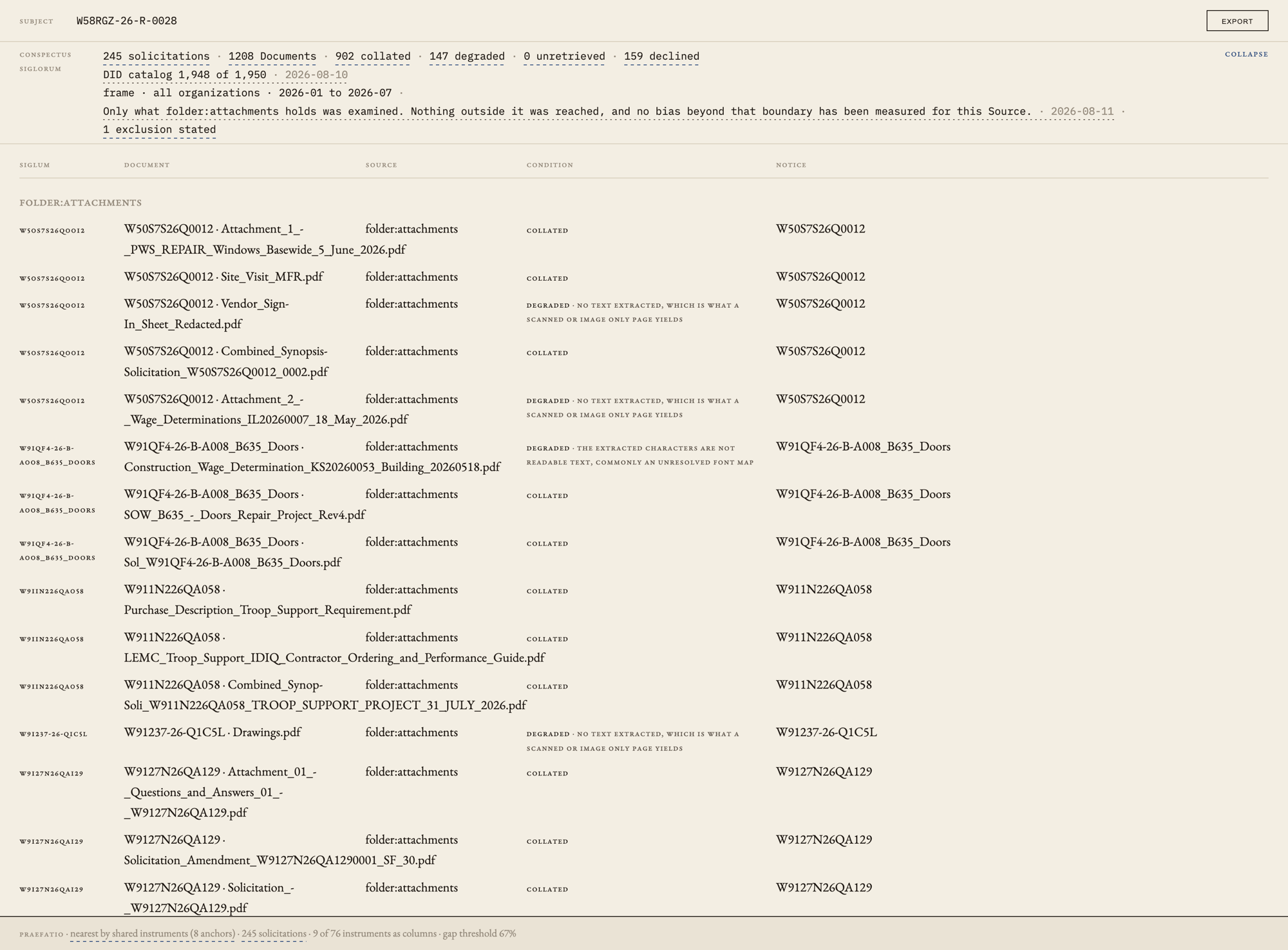
The distinction the tools around it do not draw
Citing sources is table stakes. What is unclaimed is separating an obligation that is genuinely absent from one that is merely unread, and being loud about the second.
The document carries the obligation, and the citation behind it resolves to a byte offset. Quiet, because presence is the expected case.
The full document set was parsed and the obligation is not in it. A real finding, stated without alarm.
PEDIGREE could not see. A scanned page, a file it declined, a source it could not reach. The material it cannot read is plausibly the most requirement dense in the corpus.
Convention says missing data is grey. Here it is inverted on purpose. Red is spent on the Blank and on nothing else in the entire product: not on errors, not on warnings, not on destructive actions. If red appears anywhere else, the state model is wrong.
The mark is a hatch plus a rule rather than a red fill, because the output gets printed into briefing decks and a flat red wash desaturates to the same grey as an Absent. The loudest mark on the page would silently become the quietest.
Measured, with n stated
We have not found a published citation accuracy evaluation for anything sold into this space: no n, no rate, no method. These are the numbers behind this one.
Stored document bodies on which the scanner agrees with the implementation it was ported from. Zero token disagreements, zero offset disagreements.
Runs behind that implementation's record of zero unmarked machine derived figures and zero irrelevant citations, across four terms, two models, two prompt headers and three sittings.
Data Item Descriptions captured from DLA ASSIST with titles, dated on the page. A stale catalog does not produce a wrong cell, it produces a missing column.
Controlled files found and purged by asking the body of each document rather than its name. The name rule fired on nothing across 1,230 files.
Arms are interleaved call by call within a single sitting, never run one after the other. Output rates on these systems shift at the level of the sitting by amounts that dwarf most treatment effects, and a real measured case moved 30% to 87% for a byte identical prompt. An arm whose control was not interleaved is uninterpretable no matter how large n is.
Boundaries
Several of these are lines the product will not cross rather than features not yet built, and they are stated because a buyer in this space is right to ask.
Access
Runs on your own machine, against your own folder. One command ingests, scans, serves and opens a browser, so the working session is never a terminal.
Nothing leaves the machine, which is the only arrangement under which a document that is not yet public can be the Subject.
The hosted tier, where a capture lead pins the solicitation they are bidding and reads what comparable programs were held to before pricing it.
The output is a self contained file that opens with the network off and prints, which is what gets forwarded internally.
The scanner and the marks go out under Apache 2.0, so the safety property can be audited rather than taken on trust.
Publishing to everyone is not a gift to any one agency, and it is not described as one.